Gordon & Durrenberger Family History
families from Galloway, Scotland and Allgäu, Germany
Records, Notes, and Images – Person Page 123
Records, Notes, and Images – Person Page {0}
Marc Fortin
#3057, Deceased, (1618 - )
Child with Françoise DeRuis (1620 - )
| Son | François Xavier Fortin, dit Plermel+ (1645 - 1690) |
| Last Edited | 12 Jun 2024 |
Family Explorer
Photo Gallery

Events and Notes
- 1618BirthMarc Fortin was born in 1618 in Saint Hermel, Saint Malo, Britany, FranceG.
- 1640Marriage | Françoise DeRuisHe and Françoise DeRuis were married in 1640 in Saint Hermel, Saint Malo, Britany, FranceG.
- 1645Birth of Child | François Xavier Fortin, dit PlermelHis son François Xavier Fortin, dit Plermel, was born on 20 Aug 1645 in Ploërmel St-Armel, Morbihan, FranceG.
- Death of Spouse | Françoise DeRuisHis wife Françoise DeRuis died.
- 1690Death of Child | François Xavier Fortin, dit PlermelHis son François Xavier Fortin, dit Plermel, died on 8 Nov 1690 in Rivière-des-Prairies, Montréal, Nouvelle-FranceG.
- DeathHe died.
Françoise DeRuis
#3058, Deceased, (1620 - )
Child with Marc Fortin (1618 - )
| Son | François Xavier Fortin, dit Plermel+ (1645 - 1690) |
| Last Edited | 12 Jun 2024 |
Family Explorer
Photo Gallery

Events and Notes
- 1620BirthFrançoise DeRuis was born in 1620 in Saint Hermel, Saint Malo, Britany, FranceG.
- 1640Marriage | Marc FortinMarc Fortin and she were married in 1640 in Saint Hermel, Saint Malo, Britany, FranceG.
- 1645Birth of Child | François Xavier Fortin, dit PlermelHer son François Xavier Fortin, dit Plermel, was born on 20 Aug 1645 in Ploërmel St-Armel, Morbihan, FranceG.
- DeathShe died.
- 1690Death of Child | François Xavier Fortin, dit PlermelHer son François Xavier Fortin, dit Plermel, died on 8 Nov 1690 in Rivière-des-Prairies, Montréal, Nouvelle-FranceG.
- Death of Spouse | Marc FortinHer husband Marc Fortin died.
Jacques-Jacob Girouard
#3059, Deceased, (1648 - 1703)
Parents
| Father | François Girouard (1620 - 1693) |
| Mother | Jeanne Aucoin (1621 - 1718) |
| Last Edited | 23 Jul 2024 |
Family Explorer
Photo Gallery
Events and Notes
- 1648BirthHe was born in 1648 in Port-Royal, Acadie, Nouvelle-FranceG.
- 1693~45Death of Parent | François GirouardHis father François Girouard died in 1693 in Port-Royal, Acadie, Nouvelle-FranceG.
- 1703~55
- 1703BurialHe was buried on 28 Oct 1703 in the Garrison GraveyardG in Port-Royal, Acadie, Nouvelle-FranceG.
Find A Grave Memorial LinkCitation: 1 - 1718Death of Parent | Jeanne AucoinHis mother Jeanne Aucoin died on 18 Apr 1718 in Annapolis Royal, Acadie, British AmericaG.
- 1727Death of Partner | Marguerite GautrotHis partner Marguerite Gautrot died on 2 Aug 1727 in Annapolis Royal, Acadie, British AmericaG.
Citations
- [S828] FindAGrave.com, online website (www.findagrave.com : viewed online 2024), Memorial ID 136645223 for Jacques-Jacob Girouard. Hereinafter cited as Find A Grave, database and images.

Bishop Iranaeus Frederic Baraga
#3060, Deceased, (1797 - 1868)
| Last Edited | 20 Apr 2024 |
Family Explorer
Photo Gallery
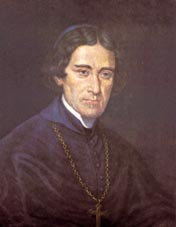
Irenaeus Frederic Baraga(1797-1868)
Events and Notes
- 1797BirthBishop Iranaeus Frederic Baraga was born on 29 Jun 1797 in Malavas, Carniola, AustriaG.
- 183538Baptism | Michel DufaultHe baptized Michel Dufault on 2 Aug 1835 at Saint Joseph's ChapelG in La Pointe, Ashland, Wisconsin, United StatesG.Citation: 1
- 183538Baptism | Julia Elizabeth CadotteHe baptized Julia Elizabeth Cadotte on 2 Aug 1835 at Saint Joseph's ChapelG in La Pointe, Michigan Territory, United StatesG.Citation: 1
- 183538Baptism | Caroline CadotteHe baptized Caroline Cadotte on 9 Aug 1835 in La Pointe, Ashland, Wisconsin, United StatesG.Citation: 1
- 183538Baptism | Marie Suzanne 'Susan' CadotteHe baptized Marie Suzanne 'Susan' Cadotte on 23 Aug 1835 at Saint Joseph's ChapelG in La Pointe, Michigan Territory, United StatesG.Citation: 1
- 183538Baptism | Jean-Baptiste 'Meshons' CadotteHe baptized Jean-Baptiste 'Meshons' Cadotte on 23 Aug 1835 at Saint Joseph's ChapelG in La Pointe, Ashland, Wisconsin, United StatesG.Citation: 1
- 183538Baptism | Edmond Fiske 'Edwin' WarrenHe baptized Edmond Fiske 'Edwin' Warren on 31 Aug 1835 at Saint Joseph's ChapelG in La Pointe, Ashland, Wisconsin, United StatesG.Citation: 1
- 183538Baptism | George Parsons WarrenHe baptized George Parsons Warren on 31 Aug 1835 at Saint Joseph's ChapelG in La Pointe, Ashland, Wisconsin, United StatesG.Citation: 1
- 183538Baptism | Antoine CadotteHe baptized Antoine Cadotte on 13 Sep 1835 at Saint Joseph's ChapelG in La Pointe, Ashland, Wisconsin, United StatesG.Citation: 1
- 183538Baptism | Anna AitkinHe baptized Anna Aitkin on 13 Sep 1835 in La Pointe, Michigan Territory, United StatesG.Citation: 1
- 183538Baptism | Maxima AitkinHe baptized Maxima Aitkin on 13 Sep 1835 in La Pointe, Michigan Territory, United StatesG.Citation: 1
- 183538Baptism | Anna ("Nancy") AitkinHe baptized Anna ("Nancy") Aitkin on 13 Sep 1835 in La Pointe, Michigan Territory, United StatesG.Citation: 1
- 183538Baptism | Mathilda AitkinHe baptized Mathilda Aitkin on 13 Sep 1835 in La Pointe, Michigan Territory, United StatesG.Citation: 1
- 183538Baptism | Magdeleine Pay-shah-quod-oquayHe baptized Magdeleine Pay-shah-quod-oquay on 13 Sep 1835 in La Pointe, Michigan Territory, United StatesG.Citation: 1
- 183538Baptism | Mary 'Maria' Cadotte WarrenHe baptized Mary 'Maria' Cadotte Warren on 3 Oct 1835 in La Pointe, Michigan Territory, United StatesG.Citation: 1
- 183638Baptism | Michael CadotteHe baptized Michael Cadotte on 7 Feb 1836 in La Pointe, Michigan Territory, United StatesG.Citation: 1
- 183639Baptism | Andre 'Andrew' CadotteHe baptized Andre 'Andrew' Cadotte on 17 Jul 1836 at Indian MissionG in La Pointe, Wisconsin Territory, United StatesG.Citation: 1
- 183639Baptism | François CadotteHe baptized François Cadotte on 21 Aug 1836 at Indian MissionG in La Pointe, Wisconsin Territory, United StatesG.Citation: 1
- 183639Baptism | Julia Ann WarrenHe baptized Julia Ann Warren on 30 Aug 1836 at Indian MissionG in La Pointe, Wisconsin Territory, United StatesG.Citation: 1
- 183639Baptism | Charlotte 'Caroline' W. WarrenHe baptized Charlotte 'Caroline' W. Warren on 30 Aug 1836 at Indian MissionG in La Pointe, Wisconsin Territory, United StatesG.Citation: 1
- 186870DeathHe died on 19 Jan 1868 at age 70.
- BiographyThe Snowshoe Priest
By Walter Thomas Camier
In June 29, 1797, Frederic Baraga, the fourth of five children, was born in Malavas in the Austrian dukedom of Carniola. His parents had him baptized as Irenaeus Frederic that very day in the parish church of Dobernice. From his earliest days, Frederic’s parents were concerned not simply with his academic education but with his spiritual and moral formation. Warning her son of the need to fight temptation, his godly mother admonished him, “Be strong, trust in the Lord, and in the end you will know victory.” Even while young, Frederic’s faith was sorely tested. He saw the family estate impoverished because of the Napoleonic wars in the region and, worse, his mother died in 1808, and his father in 1812. He often recalled his mother’s wise counsel: “Look to your Heavenly Father for the graces necessary to live a good life.”
For the next four years, Frederic attended a school in Ljubljana, where he lived in the home of Dr. George Dolinar, a lay professor at the diocesan seminary. He continued his education, studying law at the University of Vienna. It was in Vienna that Frederic met the Austrian priest Fr. Clement Maria Hofbauer, who had been inspired by the writings of Saint Alfonso de Liguori, the founder of the Redemptorists. Frederic’s friendship with Father Hofbauer awakened his vocation to the priesthood, and he devoted himself more intensely to his prayers and the sacraments, kindling the flame now burning in his soul — ardent desire to serve God as a priest.
During the summers, Frederic walked throughout the Vienna countryside and neighboring countries. These walking tours helped build the stamina he would find indispensable in his later missionary life. Frederic graduated from law school in 1821 and was ordained a priest by the bishop of Ljubljana on September 21, 1823. He was assigned to Saint Martin’s parish near Krainberg.
Counteracting the abominable heresy of Jansenism, which held a debased view of man and denigrated the spiritual benefits conferred by the sacraments, Father Baraga encouraged frequent confessions and wrote devotional works to inspire the laity to live lives of prayer and holiness. As for himself, he embraced the cross through the practice of penance, poverty, and service to the poor.
After Father Baraga created a Sodality of the Sacred Heart even though such associations were forbidden at the time by the emperor, his bishop banished him to a neglected parish in Metlika in Lower Carniola as the last among three assistant priests. Father Baraga remained steadfast in his resolve to serve the forgotten faithful, but his pastor and brother curates opposed him at every step.
Arbre Croche
Frederic Baraga's childhood home
While praying for divine guidance, Father Baraga learned of the need for missionary priests in America. Bishop Edward Fenwick of Cincinnati had sent an emissary to convince the Austrian Emperor, Francis I, to support a missionary society to help spread the Gospel in the United States. The emperor agreed and the new society was named the Leopoldine Foundation after his late daughter, Leopoldina, who had been Empress of Brazil. The American emissary granted Father Baraga’s request to work in the Indian missions, and the bishop approved his transfer. On October 29, 1830, he left his homeland to spend the remainder of his life as a missionary among American Indians.
Arriving in New York on December 31, 1830, Father Baraga journeyed to Cincinnati, which he reached on January 18, 1831. There he served the German Catholics residing in that area while beginning his studies of the Ottawa language under the instruction of the son of an Ottawa chief, who was attending the Cincinnati seminary.
On May 28, 1831, Father Baraga arrived in his first Indian mission, Arbre Croche, (near present-day Harbor Springs, Michigan), where the faithful, who had been converted by the Jesuit missionary Fr. Peter Dejean, welcomed Bishop Fenwick and their new pastor with great affection. During his four-day stay, the bishop confirmed thirty Ottawas. On his departure, Bishop Fenwick confided to Father Baraga, “I would gladly exchange my residence in Cincinnati for a small hut and the happy lot of a missionary among these good Indians.” In later years, Father Baraga would echo these words.
The “happy lot” of the missionary was not an easy one. A rough log cabin with a birch roof served as Father Baraga’s home. He had just one coat to protect himself against the frigid winter winds, during which he often had to warm the wine and water before offering his morning Mass.
One of the first articles Fr. Baraga and the other missionaries acquired was a bell he used to call his congregation to prayer. In this painting Bishop Baraga has just rung the bell and is welcoming a family of Indians.
Father Baraga was devoted to serving the souls entrusted to his care. In 1831 alone, he baptized eighty-seven Ottawa adults and forty-four children. During the two years and four months he would serve in Arbre Croche, he would baptize 547 Ottawas. He strove to better the condition of these poor souls not only spiritually but physically as well. The woodland Indians had lived a nomadic life, hunting, fishing, and gathering sap and berries. Feast and famine alternated. Under his direction, the converts at Arbre Croche began turning to agriculture and stored their harvest to last the long winter. Seeing that these Indians were adept in mechanical skills, he also established blacksmithing, carpentry, and book-binding shops for them.
Missionary journeys
Neither snow, wind, nor rain could stop this intrepid missionary from his apostolic labors, as he set out to evangelize the neighboring Indian tribes. He first focused his attention across Lake Michigan to Beaver Island, but the Indians there were hostile to the faith, so he turned to Indian Lake on Lake Michigan’s north shore where the Indians were more receptive. All but one were baptized, and a church dedicated to the Blessed Virgin was built. Father Baraga then journeyed to Detroit to proofread Animie-Misinaigan, his prayer book in the Ottawa language, returning to Arbre Croche with 2,000 bound copies.
Father Baraga often traveled many miles alone in the desolate wilderness and, finding nowhere to stay, he would lay down in the snow, pull his coat over himself, and fall asleep. More than once, he awoke to brush several inches of snow off himself before continuing his journey. Despite such hardships, he ate very little — perhaps, a small piece of bread with some water. His energy came not from food, but from his love of God and of the souls He entrusted to his care.
In the spring of 1832, Father Baraga and his Indian companions set out for Little Detroit Island on Green Bay, 30 miles across Lake Michigan. The Indians would never have embarked on such a long journey in a small canoe, save for their trust in the priest’s faith and prayers. During their voyage a storm arose, tossing the canoe in its wake. As the Indians looked to the missionary, he encouraged them to confide in God. The storm passed and they reached Detroit Island, where Father Baraga taught and baptized for eight days, and selected a site on which to build a church.
Low on supplies, the small mission band then traversed the north shore. The Indians admired Father Baraga’s willingness to sacrifice the little he had for others, but what would happen when the supplies ran out? After rising and praying in the early morning hours, he pressed on. Toward nightfall, a flock of birds drew their canoe to shore where Father Baraga and his companions gathered 130 eggs.
Grand River
Rather than returning to Arbre Croche, Father Baraga, at the urging of the Indians, spent the winter 300 miles south at Grand River (now Grand Rapids, Michigan). In a building owned by the Catholic fur trader Louis Campall, he offered Mass and instructed converts. Because his report to his new bishop in Detroit, John B. Purcell, noted eighty-six converts and the potential for more among the 900 Ottawa natives, the Bishop directed him to transfer to Grand River. A Redemptorist priest and two brothers were sent to serve the mission at Arbre Croche.
Father Baraga built a church and school. He also confronted the fur traders, who exchanged cheap whiskey for the valuable furs the Indians had trapped; he challenged them for making their bellies their god. The furious traders threatened his life and even went to his home to burn it down. It was only a visit of the sheriff — in response, no doubt, to his unceasing prayers — that saved the day.
The Indians renewed their faith, abandoning their drunkenness to return to the sacraments to nourish their souls. They found joy in their servant, Father Baraga. His speech was kind and his approach gentle, and an air of reverence pervaded all that he did. His conduct induced the Indians to trust him and believe in the Faith he professed.
After the new church was dedicated, other Catholics joined the native Catholics from up and down the river.
La Pointe
In July 1835, Bishop Purcell sent Father Baraga to La Pointe (near Bayfield, Wisconsin). This came about through the intrigues of a government agent angered that the saintly priest had used his legal training to aid Indians whom the government had treated unjustly. Suffering his own injustice with heroic virtue, Father Baraga prayed for even greater suffering so that he might offer it for the conversion of the Ojibway Indians living near Lake Superior. Both aspects of his prayers were answered. When the boat that was to have brought his winter clothing failed to arrive, he was left to spend the fierce winter with just summer clothing. The suffering bore its fruit: Our Lord’s servant baptized twenty adults and two children on Christmas Day.
Father Baraga later traveled to Fond du Lac, where he worked with a pious Catholic trader, Pierre Cotte. There he baptized another fifty-one members of the Ojibway tribe.
In 1836, Father Baraga returned to Europe to seek priests and funds for the missionary work. While there, he printed a prayer book and a life of Christ in the Ojibway and Ottawa languages. He was also received in audience by Pope Pius IX, who listened intently to his account of the American missions.
Returning to La Pointe, Father Baraga found his converts steadfastly practicing their faith. What joy filled his soul as a second, larger church and a school took shape. In 1838, the church was dedicated, and the bishop confirmed 112 adults.
L’Anse
Always seeking new souls to save, Father Baraga was asked by Pierre Crebassa, another Catholic fur trader, to come to L’Anse, on the shore of Keweenaw Bay off Lake Superior, to set up a mission for the Indians living there. He arrived in 1843 to find the village in drunken revelry. Nevertheless, he saw excellent grounds in which to plant the seeds of faith. He converted many souls and helped them build a church and log homes for their families.
During the winter and through the next summer, Father Baraga visited the missions he had founded, encouraging the faithful to persevere in the faith. He was pleased to see that, thanks to their hard work and sober living, the Indians were better prepared to endure the harsh winters. Continuing his solitary missionary treks in the winter of 1845, he traveled some 600 miles in just five weeks.
“We will be saved”
As evident from his life, Father Baraga had absolute confidence in divine Providence. Once he had to make a journey from Sand Island, off the Wisconsin shore, to Grand Portage, in present Minnesota. Rather than travel 200 miles along the coast, he insisted on canoeing across the open waters of Lake Superior. A storm arose, and Father Baraga and his Indian companion Lewis found themselves buffeted by the wind and waves. Turning to the priest, the Indian found him praying calmly. Father Baraga looked up to his friend and assured him, “We will be saved, go straight ahead.” Soon they saw a small, calm river, where they disembarked, erecting a large cross in gratitude to God and His Blessed Mother for their deliverance. To this day, the river is known as Cross River.
In the spring of 1850, Father Baraga traveled from La Pointe to Ontonagon. His companions became alarmed when the ice they were walking on broke apart and they were set adrift on an ice floe that moved farther and farther from shore. Seeing their alarm, Father Baraga comforted them. Scarcely had he spoken the words, “We will be safe,” when the wind shifted, driving them directly to the safety of the shore — close to their destination. As they left the floe, Father Baraga said with a gentle smile, “See, we have traveled a great distance, yet we have worked little.”
Heir of the Apostles
In May 1852, the First Council of Baltimore petitioned Pope Pius IX for a bishop to serve the upper peninsula of Michigan and adjacent areas of Lake Superior. That fall, Father Baraga completed his 1,700-page dictionary of the Ojibway language, a labor of twenty years. On November 1, 1853, Father Baraga was preparing to leave for Europe to beg for priests and funds when he received word of his appointment as bishop of the diocese of Sault Sainte Marie.
Arriving in Europe, Father Baraga was greeted by crowds who had read of his missionary endeavors. They were moved by the penitential life written into every line of the tanned and weathered face of the small and frail priest. During his year in Europe, five priests had promised to come to his diocese, but only two actually did so. Bishop Baraga resided in Sault Sainte Marie for the next twelve years. He regularly visited the outlying missions of his diocese, traveling by horse, sleigh, steamer, and on foot.
“Take up thy cross and follow Me.”
In 1855, Bishop Baraga lost his hearing due to an illness. It was a cross to be unable to hear the confessions of the Indians he loved so much, but he bore it heroically. Eventually, Deo gratias, his hearing returned. When ungenerous souls denigrated him for “spoiling” his Indian converts with too many kindnesses, he suffered their calumnies with his customary patience and charity.
In 1857, the stamina of Bishop Baraga, now sixty, began to fail. Despite the crippling pain he silently bore, he continued to bring the consolation of the sacraments — and of his presence — to the far-flung Indian missions, even in the midst of winter. On one such journey, Bishop Baraga was so wracked with fever that he could scarcely keep up with his Indian companions, but Divine Providence and his perseverance saw him safely to his destination.
Saved by the Cross
In 1865, Father Baraga’s episcopal seat was moved from Sault Sainte Marie to Marquette, Michigan. The following year, the Second Council of Baltimore required his attendance. As he was preparing to depart, he suffered a stroke. Nevertheless, he felt obliged to attend and traveled three long and grueling weeks, reaching Baltimore in seriously weakened health. While attending the Council, he suffered another stroke and fell down a flight of stairs. Miraculously, divine Providence intervened through the instrumentality of the bishop’s pectoral cross, which punctured his chest and caused bleeding that relieved the blood pressure within his head. While his brother bishops urged him to stay, Bishop Baraga quietly left the Council to return to his diocese of Marquette to live his final days in the company of the Indians for whom he had given his life.
For the next three years, despite the increasing burdens imposed by his failing health, he continued his labors. On January 19, 1868, after thirty-seven years of sacrificial apostolate, Bishop Frederic Baraga died, trusting in God to his dying breath.
How many of the converts this lover of souls led to Christ are now with him, God alone knows, but who can doubt that those who remained faithful are with their beloved snowshoe priest in the celestial cathedral we call heaven?
As for us here below in the ranks of the Church Militant, the cause for Bishop Baraga’s canonization having been approved by Rome, we ardently long for the day that Holy Mother Church will solemnly elevate this noble son to the lofty altars of Her saints.
Testimony regarding preservation of Bishop Baraga’s bodyBishop Baraga’s body was originally buried in the ground beneath a chapel in the old Bishop’s residence in Marquette. From there it was translated to the cathedral, at which time the casket was opened for inspection.
Msgr. Antoine Rezek, who was among those present, related what he had observed to Msgr. Zryd of Bishop Baraga Association Headquarters. Msgr. Rezek found the body still quite intact at that time. While the body had naturally decomposed, the bones were intact and the skin and features were still recognizable. It had been buried in a purple cope that still held together. Msgrs. Rezek and Hager were able to move the remains into the new casket by lifting the cope.
His remains were transferred to a new crypt. The coffin was again opened and Msgr. Zryd, then present, provided an eye-witness account. He said that the body was found as previously described by Msgr. Rezek, that is, still dressed in the purple cope and having the skull still intact and with sufficient patches of dry skin and hair to make the Bishop’s features recognizable in comparison with photographs taken during his life.
Why Snowshoes?
In this connection I will explain how a missionary has to travel during winter in this Indian country. In winter a person cannot travel otherwise than on foot. As the snow is generally deep and there are no traveled roads, the only way to travel is on snowshoes. The snowshoes are from four to five feet long and one foot wide and are tied to one’s feet. With them a man can travel even in the deepest snow without sinking in very much. But this style of walking is very tiresome, especially for Europeans, who are not accustomed to it. When the person must walk upon such snowshoes all day long, and for that many days in succession, especially in these trackless North American forests, he cannot travel without extreme fatigue and almost total exhaustion.
Another hardship is sleeping in the open air in a northern winter, for there are no huts in which to stay overnight. Generally speaking, a man may travel four or five days in this extensive and thinly settled country before coming to another Indian settlement. It is true, a large fire is made but this soon goes out, for the Indian guide who accompanies us sleeps the whole night as if he were in a feather-bed, and then a person suffers much from the cold. It is especially hard to pass the night in such a way when it storms and snows all night and in the morning a person is covered all over with snow. But all these hardships the missionary joyfully endures if thereby he can, through God’s help and grace, save even one soul.
This winter I have to make a far longer journey, that is, from L’Anse to La Pointe and Fond du Lac and return, a distance of about 690 miles! I will begin this journey, please God, on the 4th of February, and hope to be back here again before the end of March. I am going to Fond du Lac, Minnesota, to make arrangements for the building of a church there. I think, thereafter, I will not go there anymore, as now a missionary has arrived for my assistance, namely Rev. Father Otto Skolla, who spends this winter at La Pointe, where I have been for eight years."
Citations
Katherine Heck
#3061, Living, (1927 - )
Children with George D. Fisher (1928 - 2001)
| Daughter | Janet Fisher (1951 - ) |
| Son | Thomas Fisher (1953 - 2000) |
| Daughter | Connie Fisher (1954 - ) |
| Daughter | Linda Fisher (1955 - ) |
| Son | Kenneth Fisher (1956 - ) |
| Daughter | Debora Fisher (1957 - ) |
| Daughter | Sharon Fisher (1962 - ) |
| Last Edited | 20 Apr 2024 |
Family Explorer
Photo Gallery
Events and Notes
- 1927BirthKatherine Heck was born on 24 Nov 1927 in North Dakota, United StatesG.
- 195022Marriage | George D. FisherGeorge D. Fisher and she were married on 3 Jun 1950 in Hettinger, Adams, North Dakota, United StatesG.
- 195123Birth of Child | Janet FisherHer daughter Janet Fisher was born on 9 Jul 1951.
- 195325Birth of Child | Thomas Fisher
- 195426Birth of Child | Connie FisherHer daughter Connie Fisher was born on 3 Nov 1954 in Illinois, United StatesG.
- 195527Birth of Child | Linda FisherHer daughter Linda Fisher was born on 31 Oct 1955.
- 195628Birth of Child | Kenneth FisherHer son Kenneth Fisher was born on 18 Feb 1956 in Spokane, Spokane, Washington, United StatesG.
- 195729Birth of Child | Debora FisherHer daughter Debora Fisher was born on 2 May 1957 in Laramie, Albany, Wyoming, United StatesG.
- 196234Birth of Child | Sharon FisherHer daughter Sharon Fisher was born on 9 Feb 1962 in Walla Walla, Walla Walla County, Washington, United StatesG.
- DivorceShe was divorced.
- 200072Death of Child | Thomas FisherHer son Thomas Fisher died on 13 Apr 2000 in Spokane, Spokane, Washington, United StatesG.
- 200173Death of Spouse | George D. FisherHer husband George D. Fisher died on 12 Nov 2001 in Spokane, Spokane, Washington, United StatesG.
Ralph Koch
#3062, Deceased, (1927 - 1984)
| Last Edited | 19 Feb 2025 |
Family Explorer
Photo Gallery
Events and Notes
- 1927
- 196234Marriage | Vivian Rose FisherHe and Vivian Rose Fisher were married on 23 Jun 1962 in Seattle, King, Washington, United StatesG.
- 198456
- NoteThey had no children.
Citations
Virginia Bledsoe
#3063, Living, (1946 - )
Children with Gordon Henry Fisher (1935 - 1998)
| Daughter | Mary Kathleen Fisher (Abt 1978 - ) |
| Son | Patrick J. 'PJ' Fisher+ (1980 - ) |
| Last Edited | 20 Apr 2024 |
Family Explorer
Photo Gallery
Events and Notes
- 1946BirthVirginia Bledsoe was born on 15 Mar 1946 in Washington, United StatesG.
- 197327Marriage | Gordon Henry Fisher
 Gordon Henry Fisher and she were married on 20 Jul 1973 in Kent, King, Washington, United StatesG.
 - 1978~32Birth of Child | Mary Kathleen FisherHer daughter Mary Kathleen Fisher was born abt 1978 in Seattle, King, Washington, United StatesG.
- 198034Birth of Child | Patrick J. 'PJ' FisherHer son Patrick J. 'PJ' Fisher was born on 10 Nov 1980 in Seattle, King, Washington, United StatesG.
- 199852Death of Spouse | Gordon Henry FisherHer husband Gordon Henry Fisher died on 9 Oct 1998 in Moses Lake, Grant, Washington, United StatesG.
Mary Kathleen Fisher
#3064, Living, (Abt 1978 - )
Parents
| Father | Gordon Henry Fisher (1935 - 1998) |
| Mother | Virginia Bledsoe (1946 - ) |
| Last Edited | 20 Apr 2024 |
Family Explorer
Photo Gallery
Events and Notes
- 1978BirthMary Kathleen Fisher was born abt 1978 in Seattle, King, Washington, United StatesG.
- 1998~20Death of Parent | Gordon Henry FisherHer father Gordon Henry Fisher died on 9 Oct 1998 in Moses Lake, Grant, Washington, United StatesG.
Patrick J. 'PJ' Fisher
#3065, Living, (1980 - )
Parents
| Father | Gordon Henry Fisher (1935 - 1998) |
| Mother | Virginia Bledsoe (1946 - ) |
Children with Lindsay Eileen Carlson (1980 - )
| Son | Jack Carlson Fisher (2007 - ) |
| Son | Will Henry Fisher (2010 - ) |
| Last Edited | 6 Jan 2025 |
Family Explorer
Photo Gallery
Events and Notes
- 1980
- 199817Death of Parent | Gordon Henry FisherHis father Gordon Henry Fisher died on 9 Oct 1998 in Moses Lake, Grant, Washington, United StatesG.
- 2003~23
- 200524Marriage | Lindsay Eileen CarlsonHe and Lindsay Eileen Carlson were married on 23 Apr 2005 at Columbia Presbyterian ChurchG in Vancouver, Clark, Washington, United StatesG. The wedding reception was held at Royal Oaks Country Club.
- 200727Birth of Child | Jack Carlson FisherHis son Jack Carlson Fisher was born on 18 Nov 2007 in Vancouver, Clark, Washington, United StatesG.
- 201029Birth of Child | Will Henry FisherHis son Will Henry Fisher was born on 16 Jun 2010 in Vancouver, Clark, Washington, United StatesG.
Sharon Fisher
#3066, Living, (1962 - )
Parents
| Father | George D. Fisher (1928 - 2001) |
| Mother | Katherine Heck (1927 - ) |
| Last Edited | 20 Apr 2024 |
Family Explorer
Photo Gallery
Events and Notes
- 1962BirthSharon Fisher was born on 9 Feb 1962 in Walla Walla, Walla Walla County, Washington, United StatesG.
- 200139Death of Parent | George D. FisherHer father George D. Fisher died on 12 Nov 2001 in Spokane, Spokane, Washington, United StatesG.
Connie Fisher
#3067, Living, (1954 - )
Parents
| Father | George D. Fisher (1928 - 2001) |
| Mother | Katherine Heck (1927 - ) |
| Last Edited | 20 Apr 2024 |
Family Explorer
Photo Gallery
Events and Notes
- 1954BirthConnie Fisher was born on 3 Nov 1954 in Illinois, United StatesG.
- 200147Death of Parent | George D. FisherHer father George D. Fisher died on 12 Nov 2001 in Spokane, Spokane, Washington, United StatesG.
Thomas Fisher
#3068, Deceased, (1953 - 2000)
Parents
| Father | George D. Fisher (1928 - 2001) |
| Mother | Katherine Heck (1927 - ) |
| Last Edited | 20 Apr 2024 |
Family Explorer
Photo Gallery
Events and Notes
- 1953
- 200046DeathHe died on 13 Apr 2000 at age 46 in Spokane, Spokane, Washington, United StatesG.
- 2001Death of Parent | George D. FisherHis father George D. Fisher died on 12 Nov 2001 in Spokane, Spokane, Washington, United StatesG.
Kenneth Fisher
#3069, Living, (1956 - )
Parents
| Father | George D. Fisher (1928 - 2001) |
| Mother | Katherine Heck (1927 - ) |
| Last Edited | 20 Apr 2024 |
Family Explorer
Photo Gallery
Events and Notes
- 1956BirthKenneth Fisher was born on 18 Feb 1956 in Spokane, Spokane, Washington, United StatesG.
- 200145Death of Parent | George D. FisherHis father George D. Fisher died on 12 Nov 2001 in Spokane, Spokane, Washington, United StatesG.
Janet Fisher
#3070, Living, (1951 - )
Parents
| Father | George D. Fisher (1928 - 2001) |
| Mother | Katherine Heck (1927 - ) |
| Last Edited | 20 Apr 2024 |
Family Explorer
Photo Gallery
Events and Notes
- 1951BirthJanet Fisher was born on 9 Jul 1951.
- 200150Death of Parent | George D. FisherHer father George D. Fisher died on 12 Nov 2001 in Spokane, Spokane, Washington, United StatesG.
Linda Fisher
#3071, Living, (1955 - )
Parents
| Father | George D. Fisher (1928 - 2001) |
| Mother | Katherine Heck (1927 - ) |
| Last Edited | 20 Apr 2024 |
Family Explorer
Photo Gallery
Events and Notes
- 1955BirthLinda Fisher was born on 31 Oct 1955.
- 200146Death of Parent | George D. FisherHer father George D. Fisher died on 12 Nov 2001 in Spokane, Spokane, Washington, United StatesG.
Debora Fisher
#3072, Living, (1957 - )
Parents
| Father | George D. Fisher (1928 - 2001) |
| Mother | Katherine Heck (1927 - ) |
| Last Edited | 20 Apr 2024 |
Family Explorer
Photo Gallery
Events and Notes
- 1957BirthDebora Fisher was born on 2 May 1957 in Laramie, Albany, Wyoming, United StatesG.
- 200144Death of Parent | George D. FisherHer father George D. Fisher died on 12 Nov 2001 in Spokane, Spokane, Washington, United StatesG.
James Manson Lee Jones
#3073, Deceased, (1886 - 1948)
Parents
| Father | James Bailey 'Poppy' Jones (1865 - 1942) |
| Mother | Candiece 'Kansas' Canada (1866 - 1905) |
Children with Lucinda ("Lucy") Wakeman (1894 - 1989)
| Son | William Basil Bailey Jones+ (1914 - 1980) |
| Son | James Simon Gabriel Jones+ (1915 - 2004) |
| Daughter | Amanda Marie Jones+ (1917 - 1990) |
| Daughter | Hattie Mae Jones+ (1919 - 2010) |
| Daughter | Bertha Margarette Jones+ (1921 - 2013) |
| Daughter | Estelle 'Stella' Irene Jones+ (1923 - 2005) |
| Son | Winson Jones+ (1925 - 2018) |
| Son | Gerald Franklin Jones (1928 - 1928) |
| Son | Russell Everett Jones+ (1929 - 2009) |
| Person appears on these charts and lists: | Descendants of James Baily (Poppy) Jones |
| Last Edited | 31 Aug 2024 |
Family Explorer
Photo Gallery


Jesse Jones and relatives
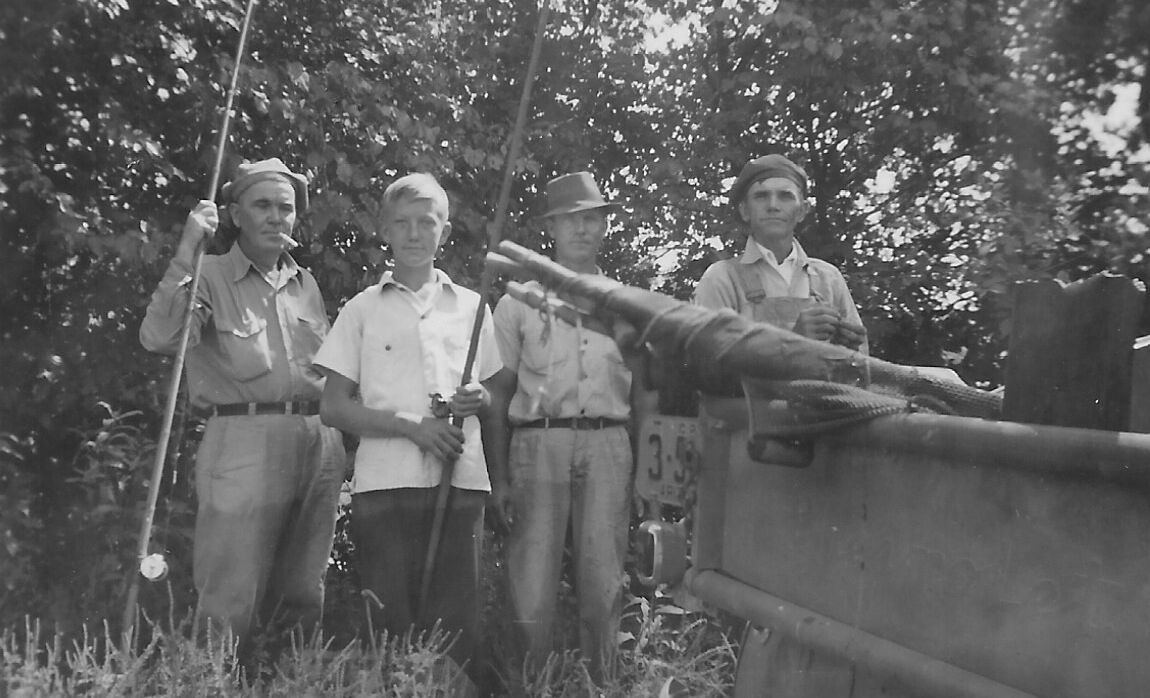
Jesse Jones, Billy Joe Cooper, Bill Jones, Manson Lee Jones
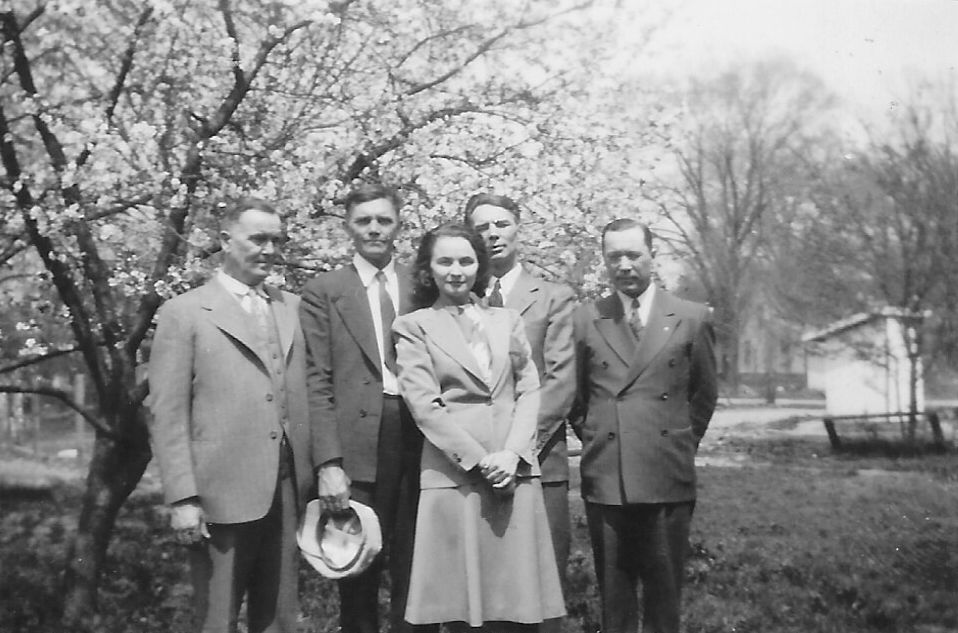
Jesse O Jones, Manson Lee Jones, Sally Jones, Edgar Jones, Frank Jones
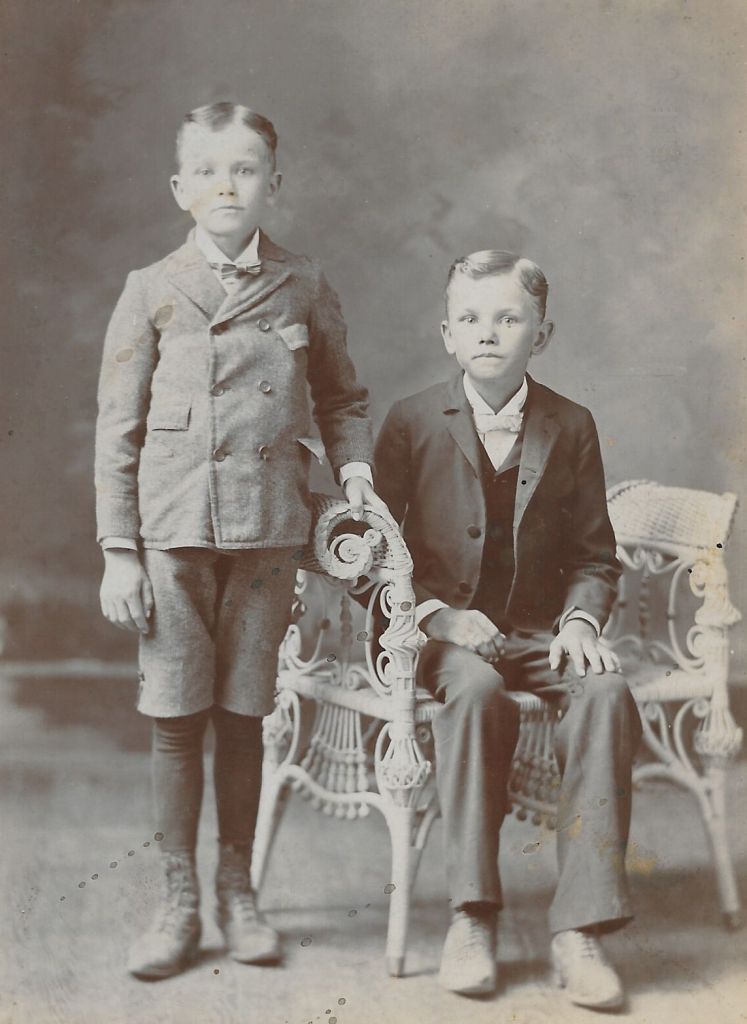
Manson Lee and Jesse Otis Jones
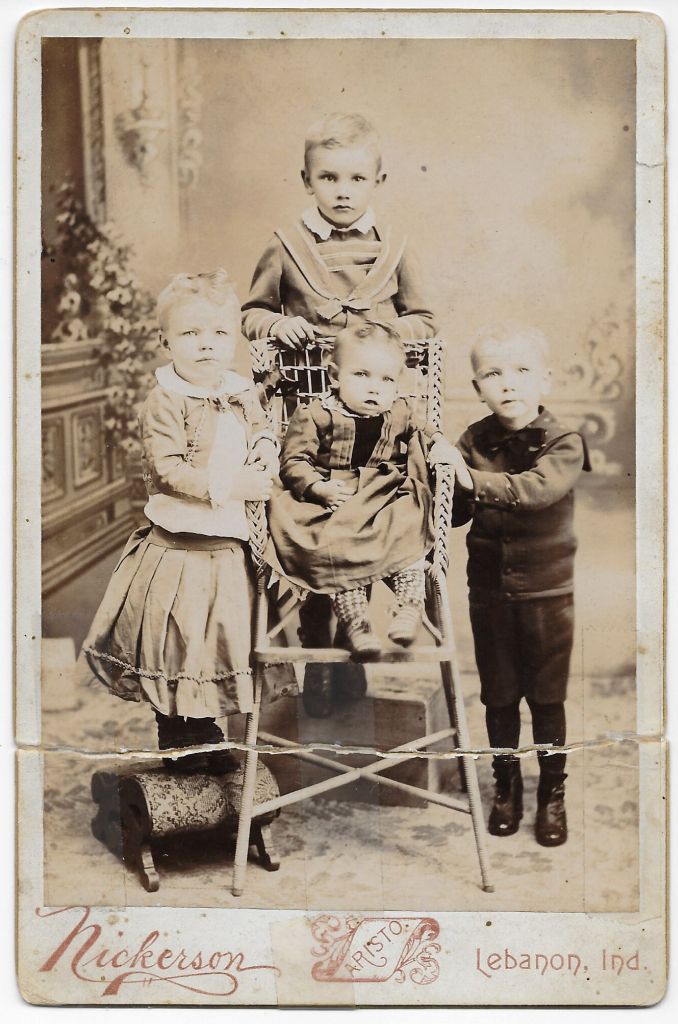
Manson, Jesse, Minnie and Hattie Jones
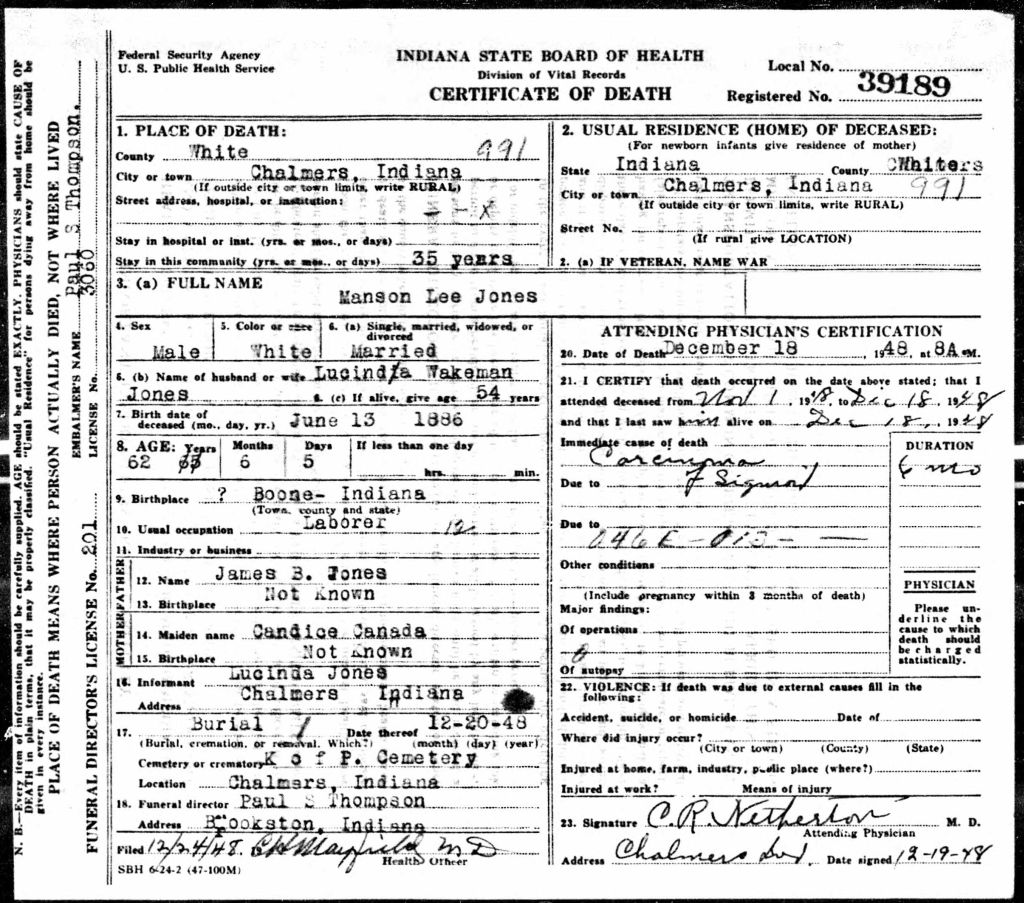
Manson Lee Jones death 1948
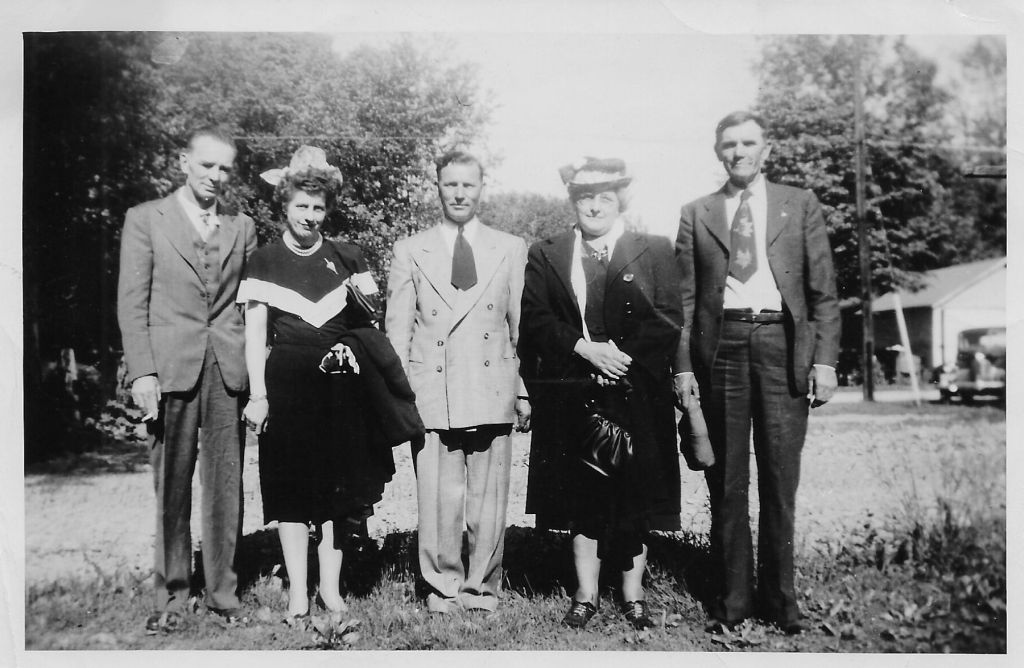
Edgar Jones, Lenora Hedshire Jones, Bill Jones, Lucinda Wakeman Jones, Manson Lee Jones
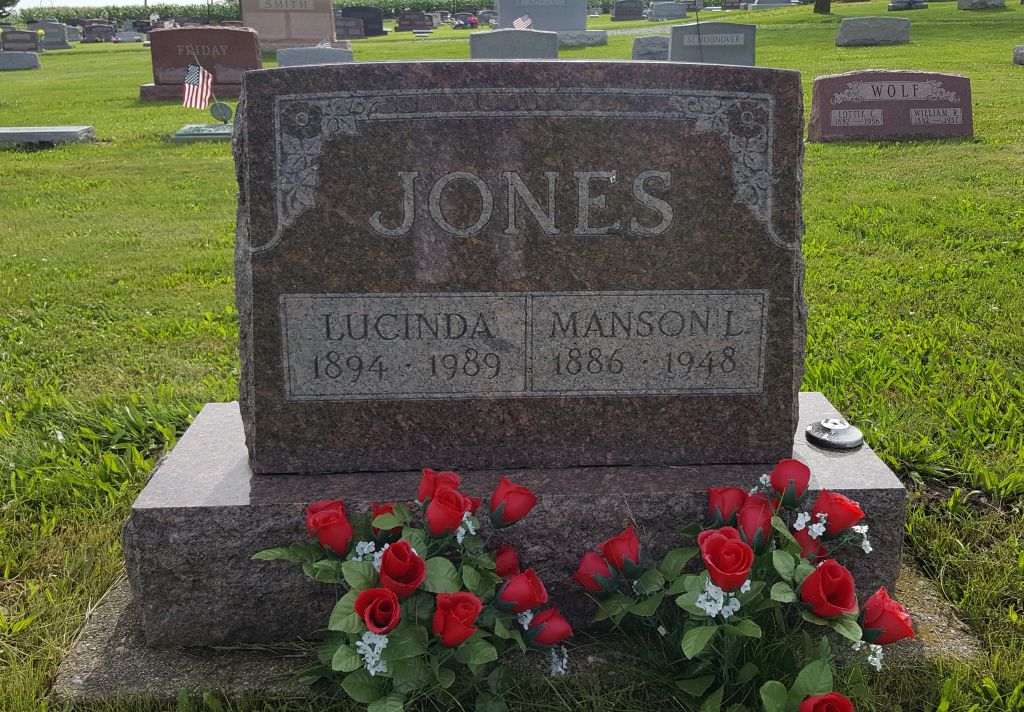
Lucinda Wakeman (1894-1989), and husband Manson L. Jones (1886-1948), Chalmers Cemetery, Indiana
Events and Notes
- 1886
- 190519Death of Parent | Candiece 'Kansas' CanadaHis mother Candiece 'Kansas' Canada died on 30 Sep 1905 in Jamestown, Boone, Indiana, United StatesG.
- 191327Marriage | Lucinda ("Lucy") Wakeman
 He and Lucinda ("Lucy") Wakeman were married on 5 Jul 1913 in Lafayette, Tippecanoe, Indiana, United StatesG.
 - 191427Birth of Child | William Basil Bailey JonesHis son William Basil Bailey Jones was born on 19 Apr 1914 in Chalmers, White, Indiana, United StatesG.
- 191529Birth of Child | James Simon Gabriel JonesHis son James Simon Gabriel Jones was born on 5 Oct 1915 in Chalmers, White, Indiana, United StatesG.
- 1917~31
- 191730Birth of Child | Amanda Marie JonesHis daughter Amanda Marie Jones was born on 10 Mar 1917 in Chalmers, White, Indiana, United StatesG.
- 191730
- 191932Birth of Child | Hattie Mae JonesHis daughter Hattie Mae Jones was born on 17 May 1919 in Chalmers, White, Indiana, United StatesG.
- 192134Birth of Child | Bertha Margarette JonesHis daughter Bertha Margarette Jones was born on 14 Apr 1921 in Chalmers, White, Indiana, United StatesG.
- 192336Birth of Child | Estelle 'Stella' Irene JonesHis daughter Estelle 'Stella' Irene Jones was born on 24 Feb 1923 in Chalmers, White, Indiana, United StatesG.
- 192539Birth of Child | Winson JonesHis son Winson Jones was born on 5 Nov 1925 in Chalmers, White, Indiana, United StatesG.
- 192841Birth of Child | Gerald Franklin JonesHis son Gerald Franklin Jones was born on 12 Apr 1928 in Chalmers, White, Indiana, United StatesG.
- 192841Death of Child | Gerald Franklin JonesHis son Gerald Franklin Jones died on 25 Apr 1928 in Chalmers, White, Indiana, United StatesG.
- 192943Birth of Child | Russell Everett JonesHis son Russell Everett Jones was born on 21 Dec 1929 in Chalmers, White, Indiana, United StatesG.
- 1930~44
- 194255Death of Parent | James Bailey 'Poppy' JonesHis father James Bailey 'Poppy' Jones died on 22 Apr 1942 in Jamestown, Boone, Indiana, United StatesG.
- 194862
- 194862
- 194862BurialHe was buried in Dec 1948 in the Chalmers CemeteryG in Chalmers, White, Indiana, United StatesG.
Find A Grave Memorial LinkCitation: 4 - 1989Death of Spouse | Lucinda ("Lucy") WakemanHis wife Lucinda ("Lucy") Wakeman died on 28 Dec 1989 in West Lafayette, Tippecanoe, Indiana, United StatesG.
Census and Residence Events
- 190014Census1900 | James Bailey 'Poppy' JonesJames was enumerated as the son of James Bailey 'Poppy' Jones on the 1900 US Census in Jackson Township, Boone, Indiana, United StatesG. He was 14 years old.
Also residing in the same household were Candiece 'Kansas' Canada, Jesse Otis Jones, Minnie B. Jones, Garnet Inez 'Iris' Jones, Franklin Benjamin 'Frank' Jones, Edgar Milroy Jones, Agnes Brownie Jones, and William Bryan Jones.Citation: 5 - 191023Census1910 | James Bailey 'Poppy' JonesJames was enumerated as the son of James Bailey 'Poppy' Jones on the 1910 US Census in Walnut, Montgomery, Indiana, United StatesG. He was 23 years old.
Also residing in the same household were Jesse Otis Jones, Minnie B. Jones, Garnet Inez 'Iris' Jones, Franklin Benjamin 'Frank' Jones, Edgar Milroy Jones, Agnes Brownie Jones, William Bryan Jones, Bessie Gladys Jones, and Sally Rita Jones.Citation: 6 - 193043Census1930He was enumerated as the head of the household on the 1930 US Census in Chalmers, White, Indiana, United StatesG. He was 43 years old.
Also residing in the same household were William Basil Bailey Jones, James Simon Gabriel Jones, Amanda Marie Jones, Hattie Mae Jones, Bertha Margarette Jones, Estelle 'Stella' Irene Jones, Winson Jones, Russell Everett Jones, and Lucinda ("Lucy") Wakeman.Citation: 2
Citations
- [S234] Military Records, World War I Selective Service System Draft Registration Cards, 1917-1918, 4,582 Microfilm Rolls (Washington D.C.: National Archives and Records), citing Jones, James Manson Lee. Hereinafter cited as World War I Draft Registration Cards, (1917-1918.)
- [S238] Ancestry.com online database, online https://www.ancestry.com, 1930 US Census. Hereinafter cited as Ancestry.com.
- [S238] Ancestry.com, online https://www.ancestry.com, Indiana, Death Certificates, 1899-2011.
- [S828] FindAGrave.com, online website (www.findagrave.com : viewed online 2024), Memorial ID 25763102 for Manson Lee “Mink” Jones. Hereinafter cited as Find A Grave, database and images.
- [S238] Ancestry.com, online https://www.ancestry.com, 1900 US Census.
- [S238] Ancestry.com, online https://www.ancestry.com, 1910 US Census.
Lucinda ("Lucy") Wakeman
#3074, Deceased, (1894 - 1989)
Parents
| Father | William Henry Wakeman (1856 - 1922) |
| Mother | Nancy Amanda Myers (1858 - 1927) |
Children with James Manson Lee Jones (1886 - 1948)
| Son | William Basil Bailey Jones+ (1914 - 1980) |
| Son | James Simon Gabriel Jones+ (1915 - 2004) |
| Daughter | Amanda Marie Jones+ (1917 - 1990) |
| Daughter | Hattie Mae Jones+ (1919 - 2010) |
| Daughter | Bertha Margarette Jones+ (1921 - 2013) |
| Daughter | Estelle 'Stella' Irene Jones+ (1923 - 2005) |
| Son | Winson Jones+ (1925 - 2018) |
| Son | Gerald Franklin Jones (1928 - 1928) |
| Son | Russell Everett Jones+ (1929 - 2009) |
| Last Edited | 2 Aug 2024 |
Family Explorer
Photo Gallery
Jesse Jones and relatives
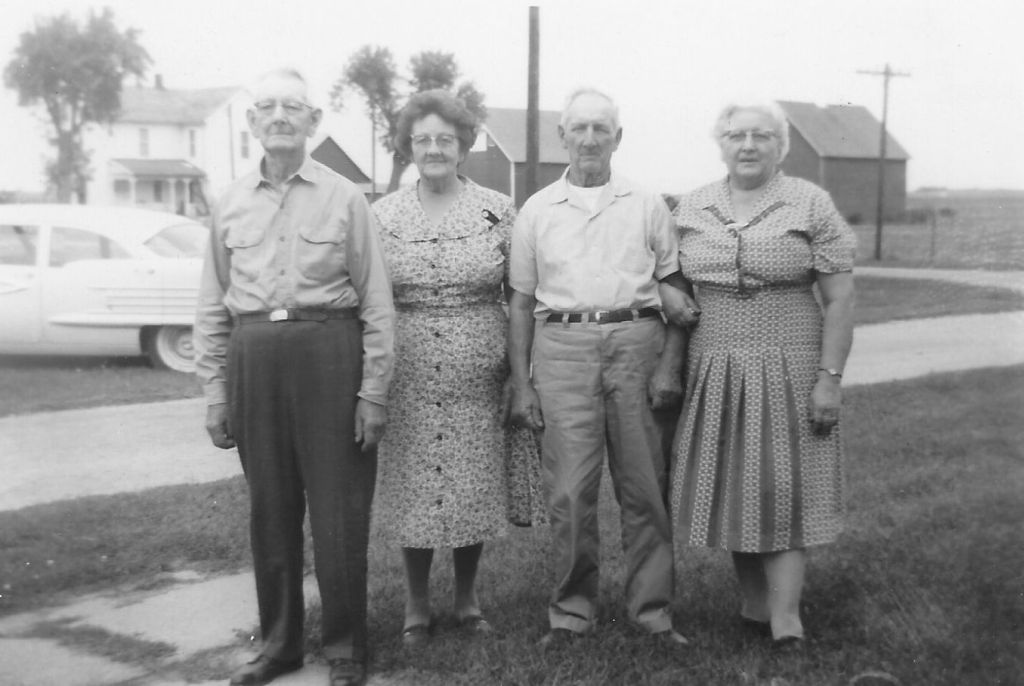
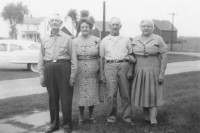
Jesse, Dora, Floyd and Lucinda Wakeman
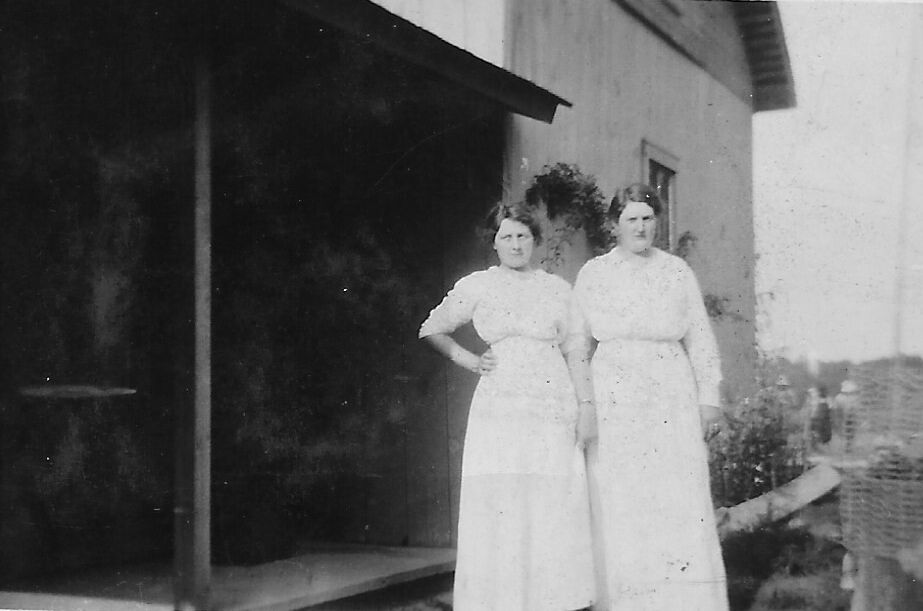
Lucy and Nellie Wakeman (l to r)
Edgar Jones, Lenora Hedshire Jones, Bill Jones, Lucinda Wakeman Jones, Manson Lee Jones
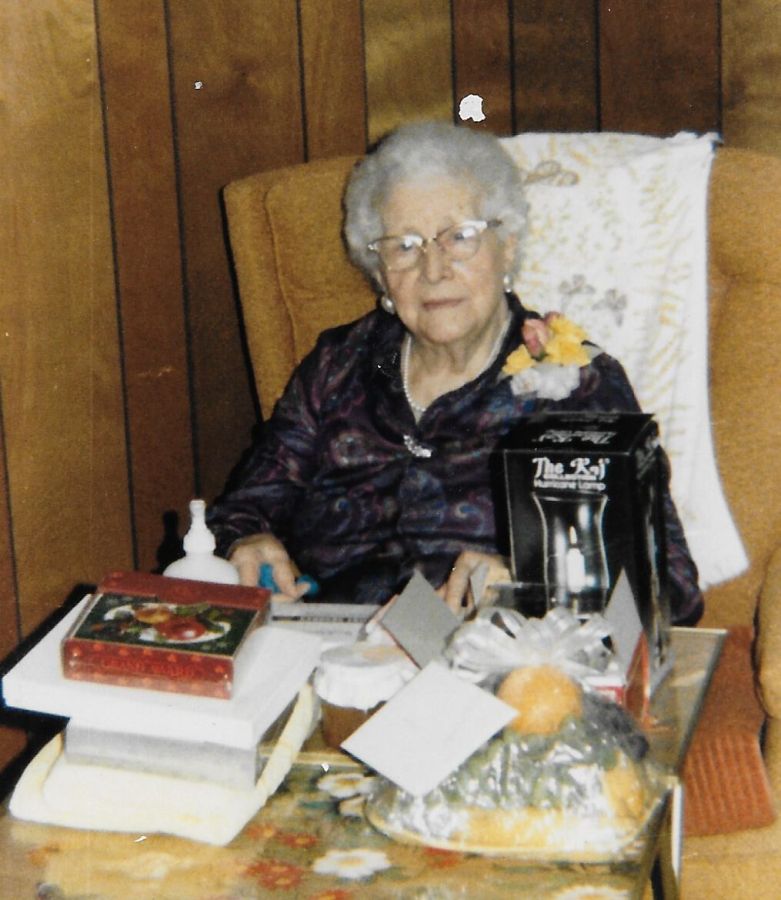
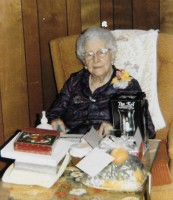
Lucinda Wakeman Jones-birthday 1984
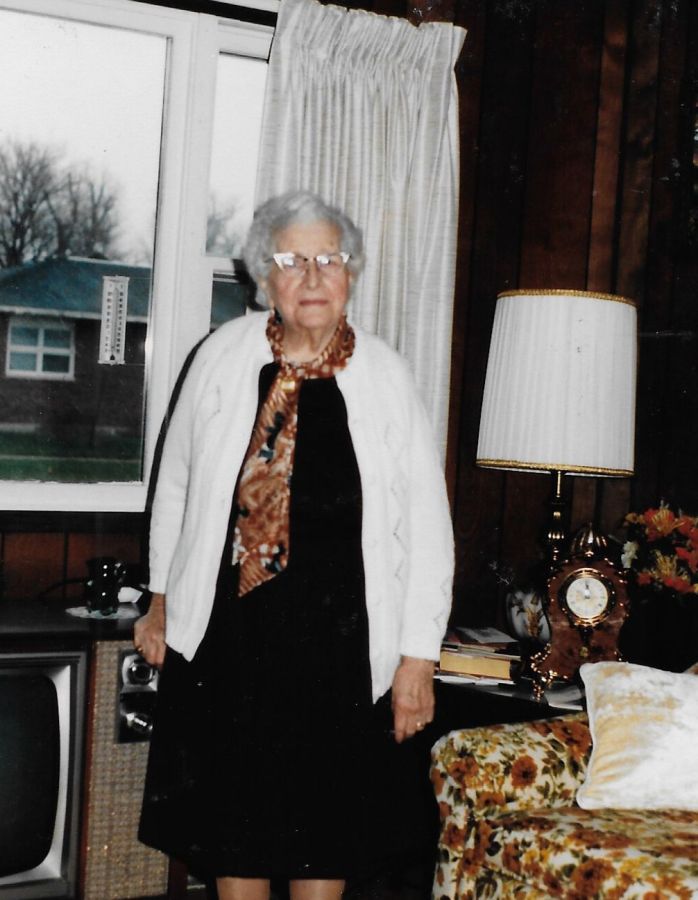
Lucinda Wakeman Jones-birthday 1984a
Lucinda Wakeman (1894-1989), and husband Manson L. Jones (1886-1948), Chalmers Cemetery, Indiana
Events and Notes
- 1894BirthLucinda ("Lucy") Wakeman was born on 17 Nov 1894 in Round Grove Township, White, Indiana, United StatesG.
- 191318Marriage | James Manson Lee JonesJames Manson Lee Jones and she were married on 5 Jul 1913 in Lafayette, Tippecanoe, Indiana, United StatesG.
- 191419Birth of Child | William Basil Bailey JonesHer son William Basil Bailey Jones was born on 19 Apr 1914 in Chalmers, White, Indiana, United StatesG.
- 191520Birth of Child | James Simon Gabriel JonesHer son James Simon Gabriel Jones was born on 5 Oct 1915 in Chalmers, White, Indiana, United StatesG.
- 191722Birth of Child | Amanda Marie JonesHer daughter Amanda Marie Jones was born on 10 Mar 1917 in Chalmers, White, Indiana, United StatesG.
- 191924Birth of Child | Hattie Mae JonesHer daughter Hattie Mae Jones was born on 17 May 1919 in Chalmers, White, Indiana, United StatesG.
- 192126Birth of Child | Bertha Margarette JonesHer daughter Bertha Margarette Jones was born on 14 Apr 1921 in Chalmers, White, Indiana, United StatesG.
- 192227Death of Parent | William Henry WakemanHer father William Henry Wakeman died on 26 Jun 1922 in Jackson Township, Elkhart, Indiana, United StatesG.
- 192328Birth of Child | Estelle 'Stella' Irene JonesHer daughter Estelle 'Stella' Irene Jones was born on 24 Feb 1923 in Chalmers, White, Indiana, United StatesG.
- 192530Birth of Child | Winson JonesHer son Winson Jones was born on 5 Nov 1925 in Chalmers, White, Indiana, United StatesG.
- 192733Death of Parent | Nancy Amanda MyersHer mother Nancy Amanda Myers died on 25 Dec 1927 in White County, Indiana, United StatesG.
- 192833Birth of Child | Gerald Franklin JonesHer son Gerald Franklin Jones was born on 12 Apr 1928 in Chalmers, White, Indiana, United StatesG.
- 192833Death of Child | Gerald Franklin JonesHer son Gerald Franklin Jones died on 25 Apr 1928 in Chalmers, White, Indiana, United StatesG.
- 192935Birth of Child | Russell Everett JonesHer son Russell Everett Jones was born on 21 Dec 1929 in Chalmers, White, Indiana, United StatesG.
- 194854Death of Spouse | James Manson Lee JonesHer husband James Manson Lee Jones died on 18 Dec 1948 in Chalmers, White, Indiana, United StatesG.
- 197075Death | Dora Margaret WakemanShe was the Informant on the Death Registration of Dora Margaret Wakeman. Dora died on 30 May 1970 at Lesley Nursing HomeG in Buck Creek, Tippecanoe, Indiana, United StatesG.Citation: 1
- 198085Death of Child | William Basil Bailey JonesHer son William Basil Bailey Jones died on 26 Feb 1980 in Lafayette, Tippecanoe, Indiana, United StatesG.
- 198995DeathShe died on 28 Dec 1989 at age 95 in West Lafayette, Tippecanoe, Indiana, United StatesG.
- 198995BurialShe was buried in Dec 1989 in the Chalmers CemeteryG in Chalmers, White, Indiana, United StatesG.
Find A Grave Memorial LinkCitation: 2 - NoteTaken from Colleen Jones Sharp's interviews with Lucinda, July and November, 1985.
I was the youngest child in my family. I had five brothers and two sisters. Their names were Charlie, Andrew, Floyd, Jess, John, Nellie, and Dora. When I was a young child, there weren't many toys to play with. Uncle Frank Wakeman gave me a bicycle, and sometimes we used a board on a fence for a teeter totter. My first teacher was Mary McArrie. In 1901 we moved to Lafayetter near Taylor Station in Tippecanoe County, IN. In 1903 my father bought a farm in Noble Co., IN. I attended a country school at Sugar Grove and a church nearby. My father sold the farm and moved to Chalmers, IN in 1905. I entered my 5th grade of school; I had Miss Burns and Mrs Temple Smith as my teachers until I graduated from 8th grade with Miss Cecile Owens. I finished my Freshman year with Miss Bessie Fisher, Professor Lawrence, and Mr. Manuel.
After my freshman year of school, I stayed at home and helped my mother, until I married Manson L Jones, in 1913, when I was almost 19 years old. I met him when I went with my parents on the train to the 100 years celebration of the Tippecanoe Battlefield, in Battle Ground. Manson was from Crawfordsville, and he tried to talk to me. I wouldn't talk to him at first, but he followed me back to Chalmers that day, and then he went back to Crawfordsville. Then later, he worked for my father, husking corn. We didn't date very long before we decided to get married. We were married in Lafayette, before a justice of the peace, and at first, lived with my parents. Later, we moved to a place east of Brookston, and Basil was born there. Manson, before we were married, and after, had a variety of jobs. He did some trapping, worked in a bait shop, fished, helped farmers, bought and sold fruit from Michigan, and drove a school hack.
When I was a young girl, I took lessons to play the organ. I think I was 13 or 14 years old. It cost $.25 per lesson. I had an organ, and later, when we still had the organ and also a piano, there wasn't room for both, so Manson gave the organ to Ralph Griffin, who still lives in Chalmers.
Census and Residence Events
- 19005Census1900 | William Henry WakemanLucinda was enumerated as the daughter of William Henry Wakeman on the 1900 US Census in Round Grove Township, White, Indiana, United StatesG. She was 5 years old.
Also residing in the same household were Nancy Amanda Myers, Charles Theodore Wakeman, Andrew Oachel Wakeman, Floyd Wakeman, Jesse Wakeman, Nellie Burley Wakeman, Dora Margaret Wakeman, and John Henry Wakeman.Citation: 3 - 191015Census1910 | William Henry WakemanLucinda was enumerated as the daughter of William Henry Wakeman on the 1910 US Census in Big Creek, White, Indiana, United StatesG. She was 15 years old.
Also residing in the same household were Nancy Amanda Myers, Charles Theodore Wakeman, Jesse Wakeman, and John Henry Wakeman.Citation: 4 - 193035Census1930 | James Manson Lee JonesLucinda was enumerated as the wife of James Manson Lee Jones on the 1930 US Census in Chalmers, White, Indiana, United StatesG. She was 35 years old.
Also residing in the same household were William Basil Bailey Jones, James Simon Gabriel Jones, Amanda Marie Jones, Hattie Mae Jones, Bertha Margarette Jones, Estelle 'Stella' Irene Jones, Winson Jones, and Russell Everett Jones.Citation: 5
Citations
- [S238] Ancestry.com online database, online https://www.ancestry.com, Indiana, Death Certificates, 1899-2011. Hereinafter cited as Ancestry.com.
- [S828] FindAGrave.com, online website (www.findagrave.com : viewed online 2024), Memorial ID 25763647 for Lucinda “Lucy” (nee Wakeman) Jones. Hereinafter cited as Find A Grave, database and images.
- [S238] Ancestry.com, online https://www.ancestry.com, 1900 US Census.
- [S238] Ancestry.com, online https://www.ancestry.com, 1910 US Census.
- [S238] Ancestry.com, online https://www.ancestry.com, 1930 US Census.
Adelheid 'Adelaide' Weibeler
#3075, Deceased, (1837 - Aft 1910)
| Relationship | Great-grandaunt of Warren McKean ("Sandy") Gordon, III, |
Parents
| Father | Johann Weibeler (1788 - 1866) |
| Mother | Anna Maria Schmitz (Abt 1801 - Aft 1858) |
Children with Gerhard 'Garrett' Hilgers (1838 - 1912)
| Son | Johann Hilgers (1860 - 1868) |
| Son | Caspar Hubert Hilgers (1866 - ) |
| Son | William H. Hilgers+ (1868 - 1963) |
| Son | Francis 'Frank' H. Hilgers+ (1870 - 1907) |
| Son | John 'Johann' Hubert Hilgers (1872 - 1949) |
| Son | Michael H. Hilgers (1873 - ) |
| Daughter | Anna Maria S. Hilgers (1875 - ) |
| Son | Caspar George N. Hilgers+ (1877 - 1959) |
| Last Edited | 16 Aug 2024 |
Family Explorer
Photo Gallery
Events and Notes
- 1837
- 18370
- 1858Death of Parent | Anna Maria SchmitzHer mother Anna Maria Schmitz died aft 1858 in Rhineland, Preußen, GermanyG.
- 186023Birth of Child | Johann HilgersHer son Johann Hilgers was born on 31 Jan 1860.
- 186528Marriage | Gerhard 'Garrett' HilgersAge 27Death: on 29 Oct 1912 | Jordan, Scott, Minnesota, United StatesGGerhard 'Garrett' Hilgers and she were married on 9 Nov 1865 in Nettesheim-Butzheim, Neuss, Rheinland, Preußen, GermanyG+.Citation: 3
- 186629Death of Parent | Johann WeibelerHer father Johann Weibeler died on 23 Feb 1866 in GermanyG.
- 186629Birth of Child | Caspar Hubert HilgersHer son Caspar Hubert Hilgers was born on 28 Sep 1866 in Nettesheim-Butzheim, Neuss, Rheinland, Preußen, GermanyG+.
- 1867~30ImmigrationShe immigrated to AmericaG, in 1867.
- 186831Death of Child | Johann HilgersHer son Johann Hilgers died on 26 Nov 1868 in Scott County, Minnesota, United StatesG.
- 186831Birth of Child | William H. HilgersHer son William H. Hilgers was born on 2 Dec 1868 in Minnesota, United StatesG.
- 187033Birth of Child | Francis 'Frank' H. HilgersHer son Francis 'Frank' H. Hilgers was born on 10 Apr 1870 in Jordan, Scott, Minnesota, United StatesG.
- 187235Birth of Child | John 'Johann' Hubert HilgersHer son John 'Johann' Hubert Hilgers was born on 26 Jan 1872 in Sand Creek, Scott, Minnesota, United StatesG.
- 187336Birth of Child | Michael H. HilgersHer son Michael H. Hilgers was born on 20 Mar 1873 in Sand Creek, Scott, Minnesota, United StatesG.
- 187538Birth of Child | Anna Maria S. HilgersHer daughter Anna Maria S. Hilgers was born on 17 Aug 1875 in Minnesota, United StatesG.
- 187740Birth of Child | Caspar George N. HilgersHer son Caspar George N. Hilgers was born on 15 Oct 1877 in Sand Creek, Scott, Minnesota, United StatesG.
- 190770Death of Child | Francis 'Frank' H. HilgersHer son Francis 'Frank' H. Hilgers died on 22 May 1907 in Madison, Dane, Wisconsin, United StatesG.
- 1910DeathShe died aft 1910.
- 1912Death of Spouse | Gerhard 'Garrett' HilgersHer husband Gerhard 'Garrett' Hilgers died on 29 Oct 1912 in Jordan, Scott, Minnesota, United StatesG.
- 1910BurialShe was buried aft 1910 in the Calvary CemeteryG, in Jordan, Scott, Minnesota, United StatesG.
Find A Grave Memorial LinkCitation: 4
Census and Residence Events
- 187538CensusMN | Gerhard 'Garrett' HilgersAdelheid was enumerated as the wife of Gerhard 'Garrett' Hilgers on the 1875 Minnesota Census in Sand Creek, Scott, Minnesota, United StatesG. She was 38 years old.
Also residing in the same household were William H. Hilgers, Francis 'Frank' H. Hilgers, John 'Johann' Hubert Hilgers, and Michael H. Hilgers. - 188043Census1880 | Gerhard 'Garrett' HilgersAdelheid was enumerated as the wife of Gerhard 'Garrett' Hilgers on the 1880 US Census in Shakopee, Scott, Minnesota, United StatesG. She was 43 years old.
Also residing in the same household were William H. Hilgers, Francis 'Frank' H. Hilgers, John 'Johann' Hubert Hilgers, Michael H. Hilgers, Anna Maria S. Hilgers, and Caspar George N. Hilgers.Citation: 5 - 190063Census1900 | Gerhard 'Garrett' HilgersAdelheid was enumerated as the wife of Gerhard 'Garrett' Hilgers on the 1900 US Census in Saint Paul, Ramsey, Minnesota, United StatesG. She was 63 years old.
Also residing in the same household were Caspar George N. Hilgers.Citation: 6 - 191073Census1910 | Gerhard 'Garrett' HilgersAdelheid was enumerated as the wife of Gerhard 'Garrett' Hilgers on the 1910 US Census residing at Ward 1G in Minneapolis, Hennepin, Minnesota, United StatesG. She was 73 years old.
Citation: 7
Citations
- [S238] Ancestry.com online database, online https://www.ancestry.com, Germany, Select Births and Baptisms, 1558-1898. Hereinafter cited as Ancestry.com.
- [S205] , International Genealogical Index (IGI) (.)
- [S238] Ancestry.com, online https://www.ancestry.com, Germany, Select Marriages, 1558-1929.
- [S828] FindAGrave.com, online website (www.findagrave.com : viewed online 2024), Memorial ID 213786272 for Adelheid (nee Weibeler) Hilgers. Hereinafter cited as Find A Grave, database and images.
- [S238] Ancestry.com, online https://www.ancestry.com, 1880 US Census.
- [S238] Ancestry.com, online https://www.ancestry.com, 1900 US Census.
- [S238] Ancestry.com, online https://www.ancestry.com, 1910 US Census.